
America Surpassed $40 Trillion in National Debt. Is This How Much It Owes?
August 21, 2026
Founder
U.S. Debt Forum
U.S. gross federal debt has surpassed $40 trillion—a remarkable financial milestone.
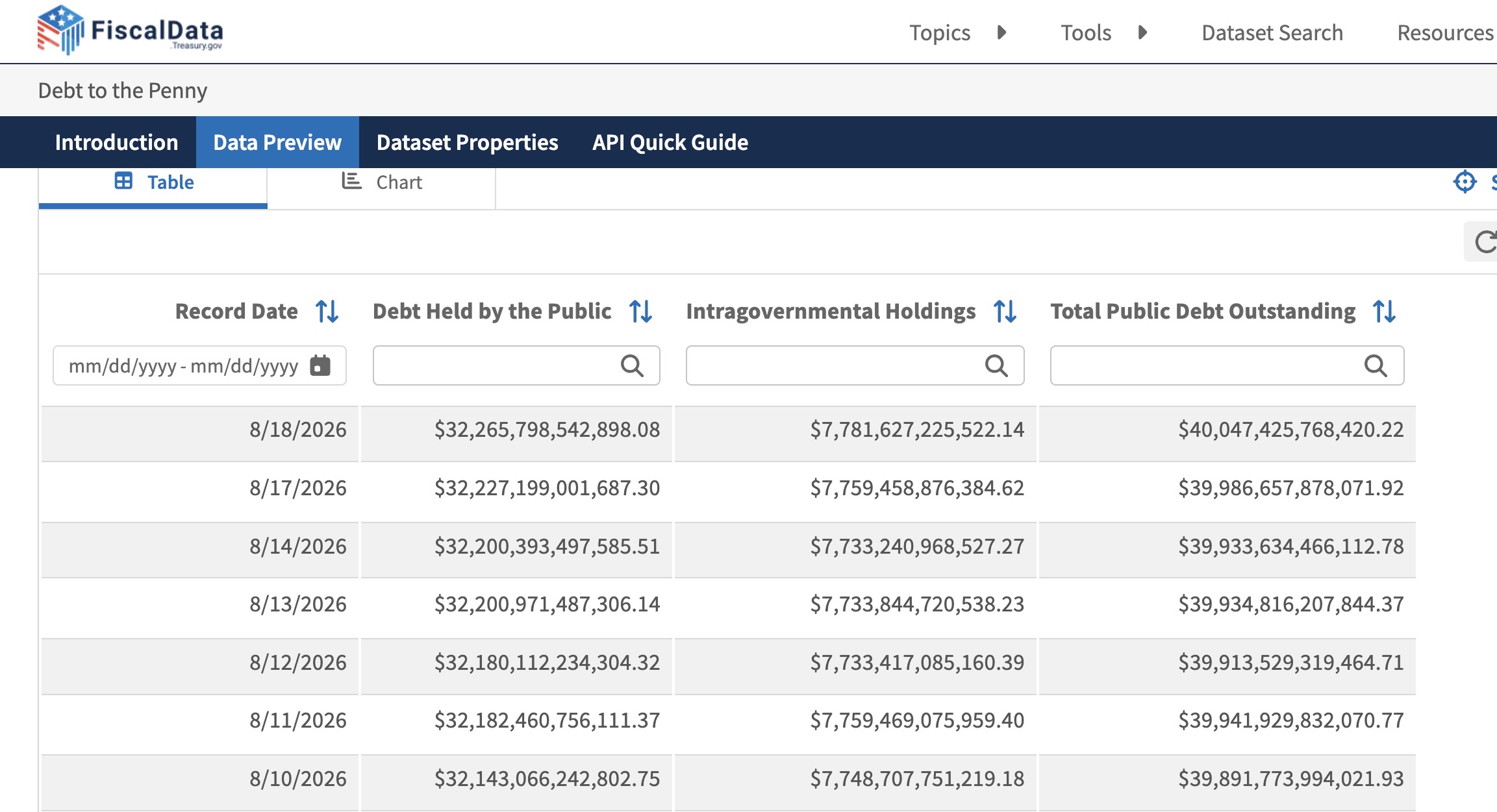
According to the U.S. Treasury's Debt to the Penny website, an official source, Total Public Debt Outstanding reached approximately $40.05 trillion on August 18, 2026. The milestone immediately generated national and international headlines and renewed discussion and debate about our nation's fiscal position and condition.
But for CPAs, the $40 trillion headline should prompt another question: What exactly is included, or not included, in that $40 trillion? The answer is more complicated—and more interesting—than the headline suggests.
The Accounting Puzzle Behind $40 Trillion
Treasury's measure of Total Public Debt Outstanding consists of two components: Debt Held by the Public and Intragovernmental Holdings. At the $40 trillion milestone, approximately $32.2 trillion was Debt Held by the Public and approximately $7.8 trillion was Intragovernmental Holdings.
Debt held by the public is the amount owed outside the federal government—to individuals, corporations, state and local governments, foreign governments, other entities and the Federal Reserve. Intragovernmental Holdings arise when one part of the federal government holds Treasury securities issued by another part of the federal government. Intragovernmental Holdings include Social Security and Medicare trust funds, for example, which are required to invest excess receipts in Treasury securities.
Both are included in gross federal debt. But from an accounting standpoint, they are different.
Debt held by the public represents an obligation to creditors considered outside the federal government. Intragovernmental holdings represent obligations between federal government accounts. The federal government is, in effect, both the issuer and the holder of those securities.
That distinction matters because the statutory debt limit is tied to gross federal debt, not simply debt held by the public. Treasury explains that gross federal debt, with certain adjustments, is subject to the statutory debt limit. The debt limit was most recently raised to $41.1 trillion in July 2025.
Thus, the $40 trillion figure is real. But it is not the only measure of federal indebtedness, and it should not be mistaken for our government's complete financial picture.
What CPAs Should Know
CPAs are accustomed to asking what a reported number actually represents. The same discipline should be applied to our federal government’s finances.
Our federal government prepares consolidated financial statements in accordance with generally accepted accounting principles for the federal government, based on standards established by the Federal Accounting Standards Advisory Board (FASAB). Its annual audited Financial Report of the United States Government includes accrual-based financial statements that present what the government owns, what it owes, its revenues, costs, bottom line, sustainability measures, comprehensive footnotes, and auditor’s opinion.
The report presents financial results that are different from and, in some respects, more concerning than the gross national debt headline.
For example, on September 30, 2025, the end of FY2025 and the date of the government's most recent published Financial Report, the Debt to the Penny website reported approximately $37.7 trillion of Total Public Debt Outstanding, or gross debt, including approximately $30.3 trillion of Debt Held by the Public and $7.4 trillion of Intragovernmental Holdings.
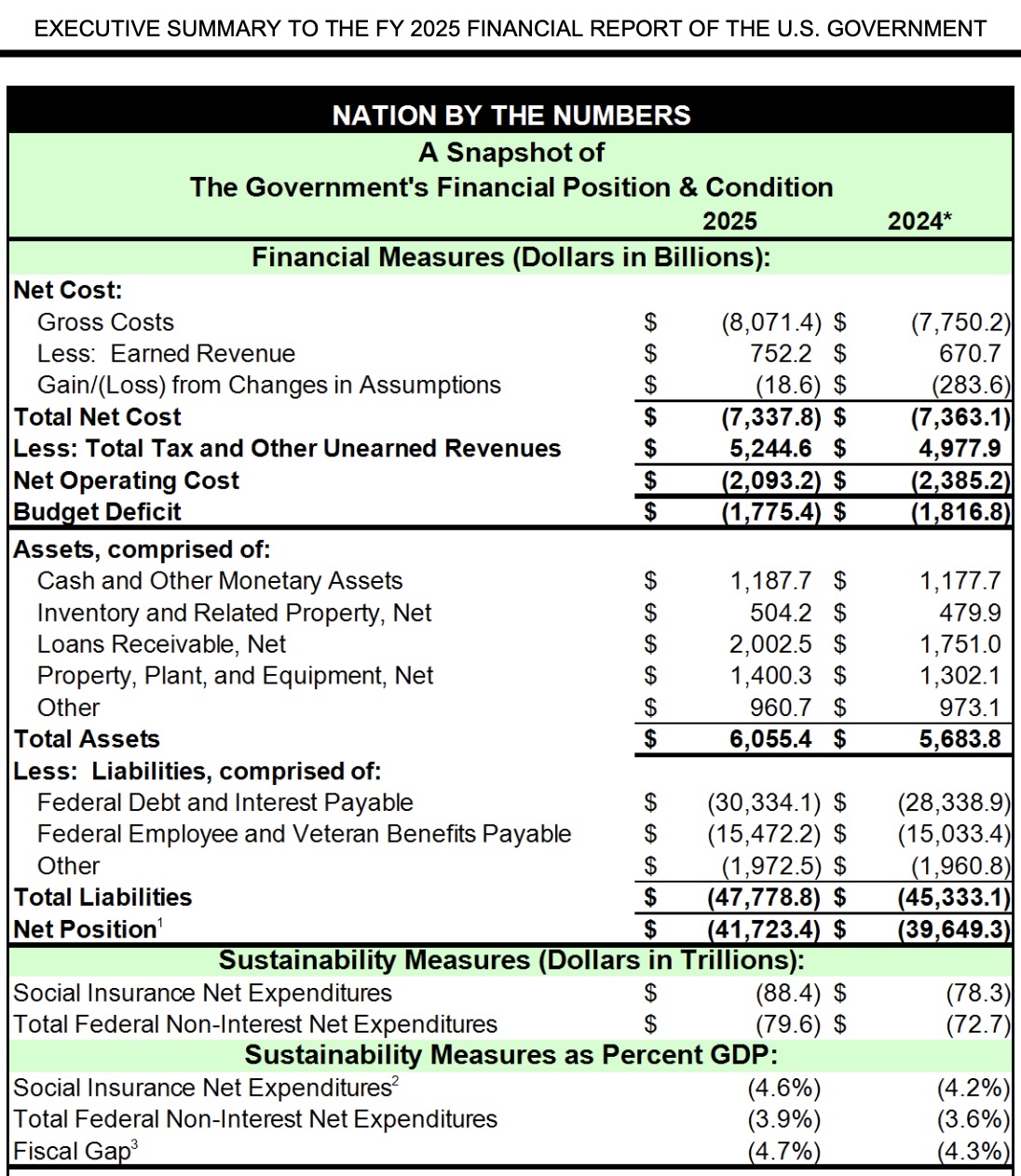
Yet the government's consolidated balance sheet reported approximately $30.3 trillion of federal debt and interest payable. Intragovernmental holdings were eliminated in consolidation and are discussed in Note 12 “Federal Debt and Interest Payable.”
But $30.3 trillion is not the total of our federal government's liabilities. Total federal liabilities were reported as $47.8 trillion, which included approximately $15.5 trillion of federal employee and veteran benefits payable, and $2.0 trillion of other liabilities.
In other words, our government's latest audited balance sheet reported approximately $17.5 trillion in liabilities beyond federal debt and interest payable. We should expect these amounts to be greater today.
These numbers are not contradictory. They answer different financial questions. The $40 trillion figure measures Total Public Debt Outstanding. The balance sheet measures liabilities recognized under federal accounting standards. And neither number, by itself, tells the entire story of the government's financial condition.
And there is another important sustainability measure of the government's long-term financial condition. The FY2025 Financial Report projects that, over the next 75 years, the present value of expenditures for Social Security, Medicare Parts A, B and D, and other social insurance programs will exceed projected revenues by approximately $88.4 trillion. This is not additional debt; it is a measure of the projected long-term financing gap in these social insurance programs.
For accountants, these distinctions are fundamental.
Why CPAs Should Care
CPAs spend their careers helping people understand financial information that can easily be misunderstood without context. A balance sheet is more than a single asset or liability number. An income statement is more than a single bottom-line figure. Financial condition cannot be understood by looking at any one number in isolation.
The same principle applies to the federal government.
The $40 trillion milestone deserves attention. It is a wake-up call about the “unsustainable trajectory” of our national debt—a clear warning repeatedly articulated in the Financial Report. But CPAs should be asking what that number measures, what it includes and excludes, how it relates to our government's audited financial statements, and what other measures are necessary to understand our government's financial position and condition.
This is particularly important because our federal government itself says its Financial Report is important to all Americans and is intended to provide information about the government's financial position, condition and changes in that position.
Yet the Financial Report remains unfamiliar to much of the public—and, arguably, to too many accounting professionals. That is a missed opportunity.
CPAs possess the training to understand accrual accounting, liabilities, financial statements and the difference between operating results and cash flows. CPAs are uniquely positioned to help the public understand federal financial information that is too often reduced to a single headline number.
The $40 Trillion Headline Is Only One Piece of the Puzzle
Our country has now crossed $40 trillion in gross federal debt. That is a historic milestone, but $40 trillion is only one piece of the puzzle.
To understand our federal government's financial position and condition, we need to examine the pieces together: gross federal debt, debt held by the public, intragovernmental holdings, total liabilities and sustainability measures. Our government's audited Financial Report puts those pieces together.
For CPAs, the $40 trillion milestone should therefore be more than another large number in the news. It should be an invitation to look behind the number, a legitimate reason for concern about our nation's fiscal trajectory, and an opportunity for CPAs to enrich the discussion of our nation's financial position and condition.
The $40 trillion headline is real.
For CPAs, who are experts at solving financial puzzles, it should be the beginning of the conversation—not the end of it.
Michael G. Doorley, CPA, is a former financial services executive with more than four decades of experience in accounting, financial management, operations and executive leadership. He writes and presents about federal government finances and is an advocate for federal financial civics. He may be contacted at mikedoorley@gmail.com.