
CPA Success Blueprint: The Four Skills That Set You Apart
January 29, 2026
Reprinted with permission of the New Jersey Society of CPAs, njcpa.org
The certified public accountant (CPA) designation is the gold standard and cornerstone of credibility; it reflects a commitment to integrity, ethics and excellence in the accounting profession.
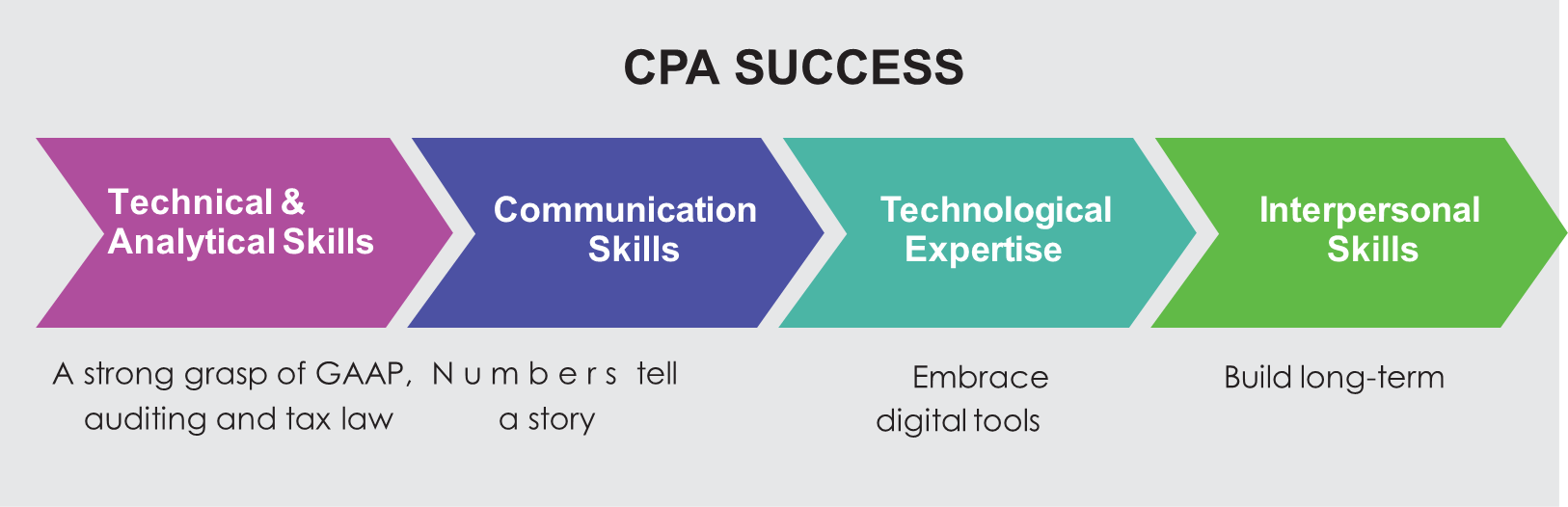
As managing partner of an accounting firm — and of equal or perhaps greater importance, the parent of a 22 year old taking the CPA Exam — there are four foundational skills that are a blueprint for a successful career in public accounting:
Technical and Analytical Skills
The core technical competencies of generally accepted accounting principles (GAAP); IRS regulations and representation; audit procedures and internal controls; and financial reporting are “sine qua non” — absolutely essential.
For early professionals, a strong understanding of technical skills is important. However, while technical skills are non-negotiable, analytical skills — the capability to analyze and interpret data — is the distinguishing factor of top-tier accountants. The ability to move beyond the numbers and interpret what they mean for a business is an essential competency. Today’s accountants are key strategic advisors who deliver value to clients and stakeholders.
Communication Skills
Communication is as foundational as technical expertise. Active listening, clarity and conciseness, as well as verbal and written skills, enable accountants to translate complex financial data in a manner that is understandable. By presenting clear financial data and communicating insights through a narrative, accountants empower clients and stakeholders to arrive at informed, data-driven solutions.
Another essential ingredient of success for a career-minded professional is the ability to recognize the best communication channel for the individual who is receiving the information (i.e., face-to-face, SMS, email, phone, client portal or video chat). Providing soft skill training is a day-one investment at our firm that pays long-term dividends. Communication is a life skill.
Technological Expertise
Technology is reshaping the accounting profession at a lightning pace, so technology expertise is essential for success. Accountants who can leverage technology will accelerate their career development.
The use of technology is everywhere. Within an audit practice, drones can be used to conduct inventory procedures at large client properties. Python, a programming language, is being used by those who want to develop data rather than just analyze it. Artificial intelligence (AI) is now being used to read leases, bank agreements and other documents based on keyword selections. Data analytics, AI, automation and specialized platforms like Power BI, Qlik Sense, Spotfire, and Tableau create real-time interactive data.
This treasure chest of data and programs provides predictive analytics and reflects the evolution from traditional accounting compliance services to strategic advisory services
As accountants handle vast amounts of data in cloud-based digital environments, the need for and the understanding of cybersecurity is yet another key area transforming the accounting landscape.
Interpersonal Skills
Interpersonal skills (IS) are vital in building relationships with others. The American Institute of CPAs (AICPA) found that 99% of firms cited “soft skills” as a central hiring consideration.
IS includes verbal communication, non-verbal communication, listening, empathy, collaboration, critical thinking, conflict resolution and emotional intelligence (EI).
According to Tom Hood, CPA, CITP, CGMA, executive vice president of business growth and engagement at the AICPA and the Chartered Institute of Management Accountants (CIMA), critical thinking is an important component of an interpersonal skill set. Critical thinking enhances interpersonal skills by enabling analysis and problem-solving. Intrinsically, critical thinking provides an unbiased view. The combination of critical thinking, EI, empathy and active listening is essential for building connections, fostering trust and establishing long-term relationships that allow clients and stakeholders to rely on our advice and recommendations.
As you advance in your career, these skill sets become differentiators that will showcase your ability to provide high-value strategic insights to your clients and stakeholders. These skills will serve you well on your path to a successful career in public accounting. The profession is changing, but the opportunities have never been greater for those prepared to lead.
Robert Traphagen, CPA, CGMA, is the managing partner at Traphagen CPAs & Wealth Advisors. He is a past president of the NJCPA and can be reached at robert@tfgllc.com.